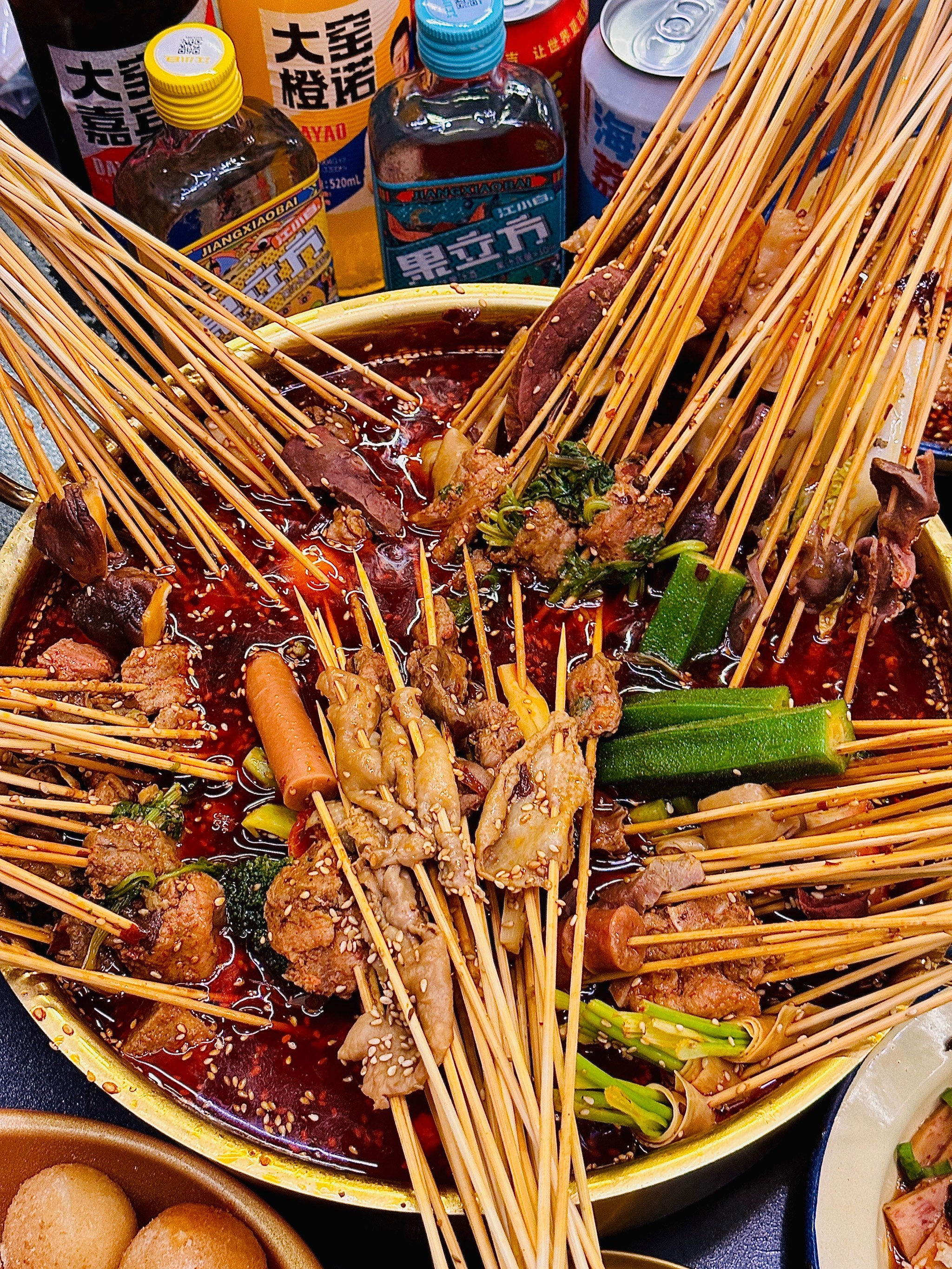
Chuanchuan (串串, chuànchuàn — literally "skewer skewer," doubled for emphasis the way Chinese often repeats a word for a casual, affectionate effect) is Sichuan street food's answer to hot pot: the same intensely spiced mala broth, the same communal cooking-at-the-table format, but with every ingredient pre-skewered onto thin bamboo sticks instead of served loose on plates. It's faster, cheaper, and arguably even more fun — the kind of meal that's as much about the ritual of picking sticks as it is about the food itself.
How it's different from regular hot pot
The cooking principle is identical to hot pot — a simmering pot of mala broth at the table, ingredients lowered in to cook, then dipped in sauce before eating. The difference is entirely in format and pricing. Where hot pot ingredients arrive on plates that diners pick up with chopsticks, chuanchuan ingredients are pre-threaded onto skewers in small, consistent portions — usually just two or three pieces per stick.
This skewer format does two practical things: it controls portion size precisely (useful for trying a huge variety of ingredients without over-ordering any single one), and it makes pricing and billing dramatically simpler — most chuanchuan restaurants charge per skewer, with sticks color-coded by price, so the final bill is just a count of how many sticks ended up on your table.
How ordering and pricing actually works
Walk into a chuanchuan restaurant and you'll typically find one of two setups: either a self-serve area where you pick skewers directly from refrigerated displays (similar to a buffet), or a menu where you tick boxes for what you want and a server brings the skewers to your table. Either way, sticks are usually color-coded or grouped by price — meat and seafood skewers cost more than vegetable or tofu skewers, for instance.
You cook the skewers yourself in the shared pot at your table, exactly like hot pot, then move them through a dipping sauce before eating. At the end of the meal, the bill is calculated by counting up the empty skewers left on your table or plate — a simple, transparent system that also makes it easy to track how much you're spending as you go.
Practical tip: keep your used skewers on the table or in a designated container rather than discarding them — most restaurants bill by stick count, and you'll need them at the end for the server to tally up your total.
What to order
The range is enormous, but a strong starting selection includes:
- Thin-sliced beef or lamb — cooks in seconds, the most essential order
- Quail eggs — a chuanchuan staple, already boiled and skewered, just needs a quick reheat in the broth
- Lotus root slices — adds crunch and absorbs the mala broth well
- Tofu skin (腐竹, fǔzhú) — folds and absorbs broth beautifully, a textural favorite
- Enoki mushrooms — bundled onto skewers, cook quickly and add a pleasant chew
- Potato slices — need slightly longer in the broth than most items, but worth the wait
The broth and the heat level
Chuanchuan broth follows the same mala tradition as Sichuan hot pot — built on doubanjiang, dried chillies, and Sichuan peppercorns, often in beef tallow for richness. Most restaurants offer a choice of spice level, and some offer a split pot with a milder broth alongside the spicy one, same as standard hot pot. Don't assume "skewer food" means casual or mild — the broth carries the full intensity of Sichuan mala regardless of the format it's served in.
Why it's worth seeking out specifically
Beyond being genuinely fun, chuanchuan offers something hot pot doesn't as easily: the ability to try a huge number of different ingredients in small quantities without committing to a large plate of any single one. It's also typically more affordable than a full hot pot meal, since you're paying per skewer rather than per plate, and it's deeply embedded in Chengdu street food culture — a meal built for casual, frequent eating rather than a special occasion.