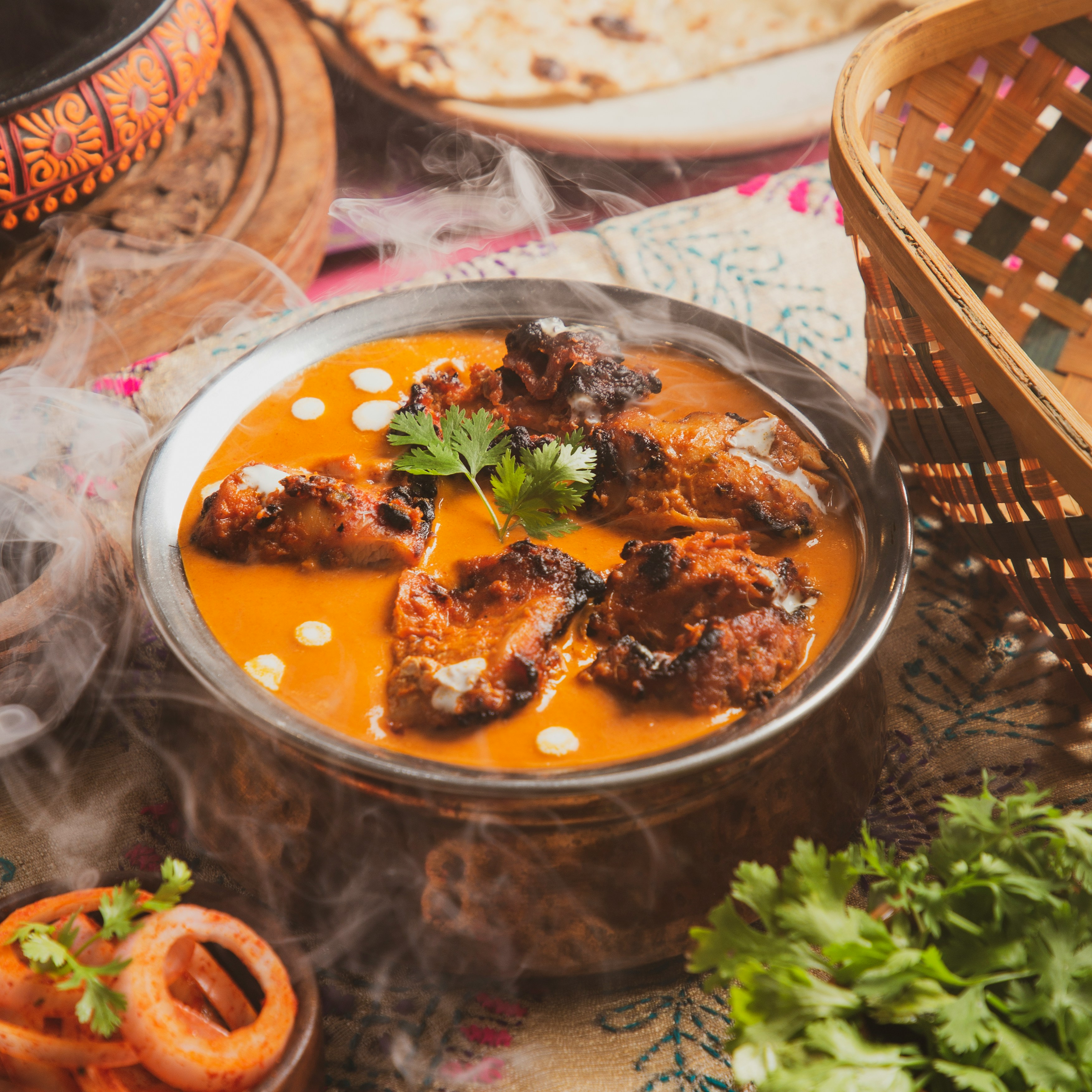
This is genuinely one of the most searched food questions on the internet, which tells you something about how similar they appear. Both are orange-red chicken curries with cream. Both appear on virtually every Indian restaurant menu. Both are popular enough to have been called "the most popular dish in Britain." So what's actually different, and does it matter which one you order?
The short answer
Butter Chicken (Murgh Makhani) is milder, creamier, and slightly sweet — designed to be universally accessible. Chicken Tikka Masala is more assertively spiced, tangier, and built for people who want more complexity from their sauce. They share a similar color and both involve tomato and cream, but they taste noticeably different when made properly.
The chicken is different
This is where the dishes diverge first, before the sauce even comes into it.
Butter Chicken traditionally uses chicken that's been cooked in a tandoor first — marinated, charred slightly, then finished in the sauce. The tandoor gives it a slightly smoky edge that persists even after it's been simmered in the makhani sauce.
Chicken Tikka Masala uses chicken tikka — specifically, boneless chicken pieces marinated in yogurt and spices, then cooked in a tandoor until the edges are distinctly charred and the surface has a slight crust. This charring is more pronounced than in Butter Chicken and adds a smoky bitterness that's a deliberate flavor component in the final dish, not just background.
In practice, many restaurants skip the tandoor and cook both proteins in a regular oven or on a grill. A true comparison requires a restaurant that uses a proper tandoor — but even then, the marinades and char levels differ.
The sauce is different
Makhani Sauce (Butter Chicken)
Built on a tomato base blended very smooth, enriched with substantial butter and cream, mildly spiced with kasuri methi (dried fenugreek leaves), garam masala, and a little chilli. The hallmarks are its silky texture and mild sweetness — it's deliberately not challenging. The butter quantity is significant; a proper makhani sauce uses far more butter than people expect.
Tikka Masala Sauce
Also tomato-based, also has cream, but with a more complex spice profile — more cumin, more coriander, cardamom, and often more chilli. The sauce is usually slightly tangier (from more tomato or a touch of yogurt), less sweet, and has a more assertive spiced quality throughout. It doesn't have the same butter-forward richness as makhani.
The origin stories are different — and both are interesting
Butter Chicken has a reasonably well-documented origin: Delhi, 1950s, Moti Mahal restaurant. The story is that leftover tandoori chicken was simmered in a tomato-butter sauce to prevent it from drying out and being wasted. The happy accident became one of the most replicated dishes in culinary history.
Chicken Tikka Masala's origin is genuinely disputed. The most cited claim is that it was created in Glasgow in the 1970s by Ali Ahmed Aslam of the Shish Mahal restaurant, when a customer complained that his chicken tikka was too dry and the chef improvised a sauce using tomato soup, cream, and spices from a can. Glasgow took this seriously enough that politicians lobbied for a Protected Designation of Origin for the dish. India disputes the claim, and multiple Indian chefs have their own origin stories. The truth is probably that the dish evolved independently in multiple places simultaneously, as fusion dishes often do.
The practical test: if you want a mild, crowd-pleasing curry that everyone at the table will enjoy, order Butter Chicken. If you want something with more spice and complexity and don't mind a slightly more assertive flavor, order Chicken Tikka Masala. If both are on a menu and the restaurant is good, order both and try them side by side — the difference becomes immediately obvious.
Why they taste the same at many restaurants
Many restaurants — especially fast-casual or busy high-volume Indian restaurants — use the same base sauce for both dishes and differentiate only with slightly different spice additions at the end. This is a shortcut that produces two dishes that taste more similar than they should. If you order both at such a restaurant and they taste essentially identical, that's why.
The distinction is most meaningful at restaurants that take the time to make each sauce from scratch, use proper tandoor-cooked chicken, and approach each dish as genuinely different rather than variations on a single base.
Which is "better"?
Neither — they're built for different preferences. Butter Chicken is the more refined, subtle dish; Tikka Masala is bolder and more varied. Most people who love Indian food eventually have a strong preference for one over the other, and that preference tells you something about their broader taste: if you prefer Butter Chicken, you probably also prefer milder, creamier curries generally. If you prefer Tikka Masala, you probably gravitate toward more complex, spicier food.